Showing posts with label science. Show all posts

Saturday, March 23, 2013

Butterflies

Since we've been talking about learning, I've been wanting for a while to talk about our real-life lesson in butterflies, and this post gave me the impetus to do it. Once again, this author is one of those completely down on public schooling; this line, particularly, "fill the void left in the child's heart after the state forcibly curtails the intellectual adventurousness of the wandering bug-studier, stargazer, or bookworm," made me think of our family's short adventure with Mona the Monarch.

It was early October of 2005. We were at one of the local outdoor malls on one of those days when winter is drawing closer to its appearance; it was cold and rainy. While we were walking, we saw a monarch butterfly on the sidewalk looking completely bedraggled. We found a cup in our car, and once the butterfly got into the dryness and warmth of our car, she immediately came back to life, fluttering around wildly. We decided we didn't want to turn her back out into the cold and damp, so we took her home and temporarily let her free in our bathroom, where she had room to fly. We had stopped on the way for a better temporary carrier for her, and some hummingbird food, the best thing we thought we could provide to nourish her. We did some research to discover that Mona was indeed a girl monarch, and that butterflies drink with their long tongues, and taste with their feet. Here you see Mona checking out the hummingbird food.

I contacted via email a group involved in tracking the yearly migration of the monarch butterfly, and was told that Mona could still make it to Mexico if she was released. So we simply waited a few days until the weather was sunny, and warm enough, and set her free, after a few pictures to remember her by.

She flew right up into the sky until she was over our house, and then headed almost due south. We like to think that she did indeed make it to Mexico, and that her descendants are still flying around somewhere.

What really brought her to mind was a comment that the Dancer made about a month ago. She is excelling in her math and science classes, and is taking Honors Geometry and Honors Biology in high school, next year, so we're not ruling out a STEM career of some sort in her future. She mentioned that she might want to have a job studying butterflies, because of her experience with Mona. That surprised me, because of how long ago our butterfly adventure took place, but it made me happy that it had left such an impression on her.

Tying it in to the article above, however, the author asserts that public school will kill the enthusiasm of the "wandering bug-studier." Granted, we were homeschooling when this all took place, but it was completely extra-curricular and spur of the moment. We could have done all of the above even if the girls were attending a public school, especially since we discovered Mona over a weekend. And the kids that my girls were friends with before we started homeschooling would at the very least not have shot down their interest. They might have thought it was interesting themselves, even if they would not have enjoyed the experience so much. The Dancer had even done a very simple "lesson" on butterflies in her preschool class.

I hate to see myself becoming an advocate for public schools, but the continuous stream of articles describing public school as nothing ever but a soul-sucking waste, make my contrarian nature want to respond that while public school is not perfect, it is in no way one hundred percent the same for everyone, everywhere. I'll probably respond more to this article in future posts, but this one was mostly to use as a jumping off point for another adventure in learning that I wanted to share.

Tuesday, March 05, 2013

Innocent Blood

So now scientists are saying that as early as 28 eight weeks gestation, babies may be able to tell different syllables apart. We learn more and more about the unborn, and about infants, and what they are able to perceive and learn. And yet there are people still defending Kermit Gosnell, an abortion practitioner going on trial, who among other atrocities killed viable infants who survived abortion. Don't go over to that link unless you want your stomach to turn.

I've grown to understand the mentality of a society that on the one hand continues to learn more and more about how complex even the unborn are in their ability to learn and process information, and on the other hand looks the other way when those same miraculous creatures are killed in horrific manners and body parts preserved in jars. The truth is, not only does evil exist, but too many people have been so swayed by emotional appeals that they overlook evil. Certainly, gruesome abortion details do create an emotional reaction on the other side. But go beyond that and think about why an unborn child deserves to be killed at all, and all of the ways to kill the unborn are pretty gruesome, when even science is telling us how, dare I say it, human, these little ones are?

Tuesday, February 26, 2013

Tales of Learning

A couple of weeks ago, I was talking to the Musician about her high school classes, and she mentioned that she was only one of two people in her physics class who knew what the definition of "work" was. I thought about it for a few seconds, then gave the definition. Then I laughed, and said the only way I knew the definition was because I remembered it from teaching the Musician science back when I was homeschooling. The Musician said that's how she knew it too, because she remembered our talking about it. A lot of homeschoolers dislike the style of teaching that I was using at the time, which was the usual public schooling method; I was using books that covered a lot of science topics (physics, biology, earth science) that became more complex in presentation each new school year. But obviously, some of it stuck with both her and me!

On the other hand, I tried Exploring Creation with Botany with the Dancer when she was in third grade or so. She didn't strictly remember a lot of what I read to her, but when she studied plant development in the fifth grade in public school, some of what we had talked about came back to her, and helped her digest what she was learning in fifth grade, better.

I used to read the education blog, D-Ed Reckoning, when it was still active, and many of my experiences as a mom of two students taught in various ways over the years reflect what he says in his last post. The kids who are easy to educate will learn. Find what works for you and go with it. In my case, my daughters have learned from a more traditional homeschooling style, from a more Charlotte Mason style, and from the regular public school approach. In fact, although my eldest daughter fought against the "school-at-home" method I tentatively started with as a new homeschooling mom, she told me only last week that she prefers the more rigid style of public school now.

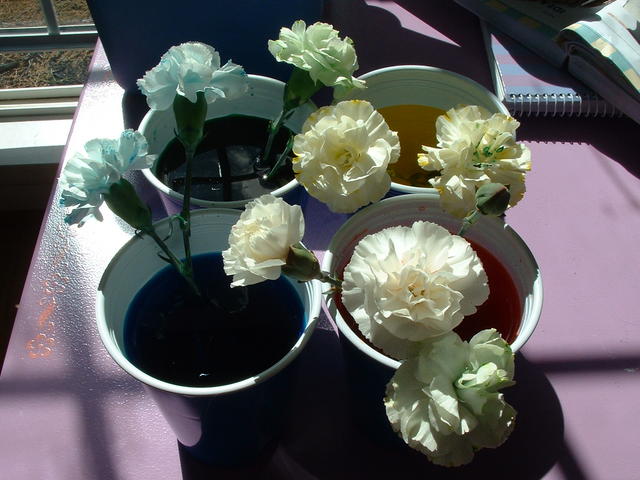
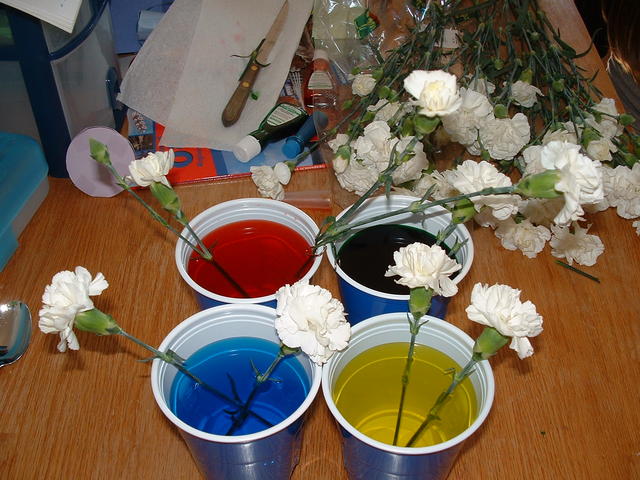
Some of what I taught them didn't "take." They don't remember much from our course on Ancient Egypt besides learning to write their own names in hieroglyphics. I doubt they remember anything from our study of Ancient Israel besides making a model of an ancient Israeli house. Are you sensing a theme here? They also will never forget the carnation and food coloring experiment, and feel sorry for kids who never did that in school. On the other hand, I doubt they remember much of anything from the museums in Chicago to which I, as a dutiful mom, took them when Mr. BTEG was living there as a consultant. But they did learn things, and I think both of them are poised to do whatever they want with their futures.

Sunday, October 26, 2008

It's Science!

Read this, and you'll know why my husband and I think it would be cool to take bananas along while trick-or-treating. It's "fashionable" around here to put a black light in the outdoor light fixture for Halloween.

Friday, September 29, 2006

Beautiful Colors

The red food coloring did not show up well, but the rest of the carnations turned out very nicely. The green carnation in the red cup is the one where I had split the stem between red and green. But the half of the stem in green broke off, so now the whole carnation is in red. We'll see what the green carnation does now! The green splatter on one of the yellow carnations is where Wildchild got a little too enthusiastic while painting something else!

Wednesday, September 27, 2006

A Classic!

When the Scientist was younger, we did the classic experiment of placing white carnations in water dyed with food coloring, to show how water is pulled up through the stem. Wildchild was too young to really remember the experiment, so we are doing it again now that Wildchild is learning about the parts of a plant. I split a stem in half that has two carnations on it, and stuck half a stem each in two separate colors. I will update you on what happens. Science!

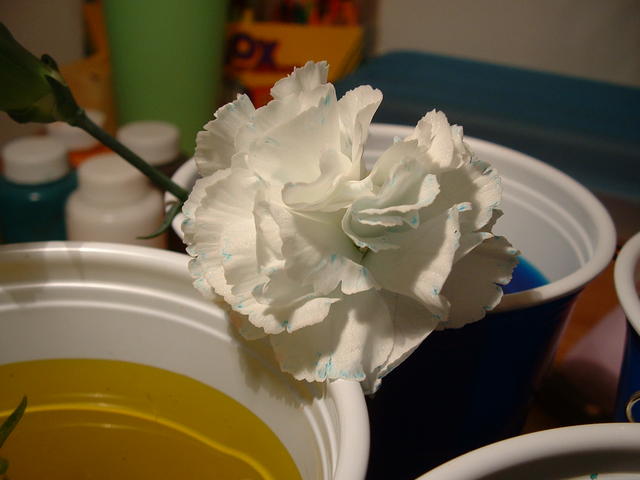
Update! The blue and green colors are already starting to show on the carnations. The carnation on half a stem is also showing some green, although not as much as the one where the whole carnation is in the green water. Here's a photo of the blue carnation, as it is the best picture I could get tonight. I'll get more tomorrow, and maybe the red and yellow will be showing up well then also.